RIP André Brink

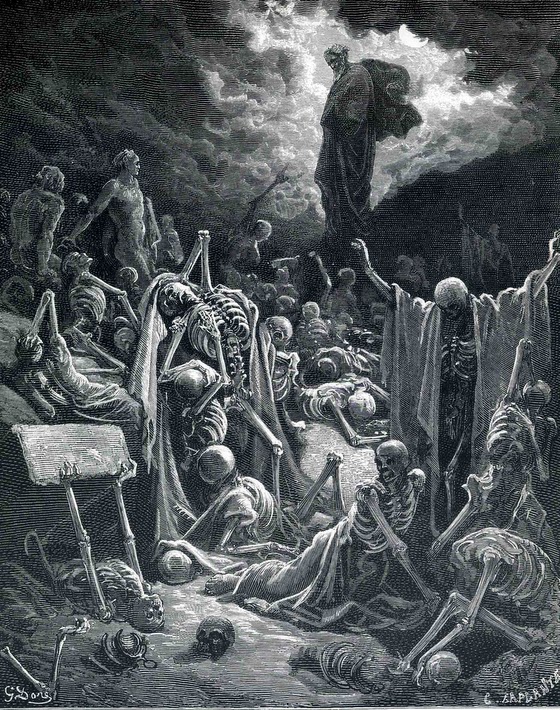
A Dry White Season by Mongane Wally Serote

It is a dry white season
dark leaves don’t last, their brief lives dry out
and with a broken heart they
dive down gently headed for the earth
not even bleeding.
it is a dry white season brother, 
only the trees know the pain as they still stand erect
dry like steel, their branches dry like wire,
indeed, it is a dry white season 
but seasons come to pass


Link | Category
Saturday | 7 February 2015 | 01:04 PM

Lucien Clergue, Nu zébré


Link | Category
Saturday | 31 January 2015 | 12:06 PM

One of the very last paintings he did before committing suicide.

Mark Rothko ~ Untitled (Black on Grey)

Mark Rothko, Untitled (Black on Grey), 1970


Link | Category
Wednesday | 28 January 2015 | 02:48 PM

Chet Baker, You Don't Know What Love Is


Link | Category
Wednesday | 28 January 2015 | 01:37 PM

Viktor Vasnetsov ~ The Knight at the Crossroads

Viktor Vasnetsov, The Knight at the Crossroads, 1878


Link | Category
Friday | 23 January 2015 | 01:20 AM

Ernst Fuchs ~ The Anti-Laocoon (Laocoon Victor)

Ernst Fuchs, The Anti-Laocoon (Laocoon Victor), 1965


Link | Category
Sunday | 18 January 2015 | 01:25 AM

Slavoj Žižek, New Statesman, 2014

Now, when we are all in a state of shock after the killing spree in the Charlie Hebdo offices, it is the right moment to gather the courage to think. We should, of course, unambiguously condemn the killings as an attack on the very substance our freedoms, and condemn them without any hidden caveats (in the style of "Charlie Hebdo was nonetheless provoking and humiliating the Muslims too much"). But such pathos of universal solidarity is not enough – we should think further.

Such thinking has nothing whatsoever to do with the cheap relativisation of the crime (the mantra of "who are we in the West, perpetrators of terrible massacres in the Third World, to condemn such acts"). It has even less to do with the pathological fear of many Western liberal Leftists to be guilty of Islamophobia. For these false Leftists, any critique of Islam is denounced as an expression of Western Islamophobia; Salman Rushdie was denounced for unnecessarily provoking Muslims and thus (partially, at least) responsible for the fatwa condemning him to death, etc. The result of such stance is what one can expect in such cases: the more the Western liberal Leftists probe into their guilt, the more they are accused by Muslim fundamentalists of being hypocrites who try to conceal their hatred of Islam. This constellation perfectly reproduces the paradox of the superego: the more you obey what the Other demands of you, the guiltier you are. It is as if the more you tolerate Islam, the stronger its pressure on you will be . . .

This is why I also find insufficient calls for moderation along the lines of Simon Jenkins's claim (in The Guardian on January 7) that our task is “not to overreact, not to over-publicise the aftermath. It is to treat each event as a passing accident of horror” – the attack on Charlie Hebdo was not a mere “passing accident of horror”. it followed a precise religious and political agenda and was as such clearly part of a much larger pattern. Of course we should not overreact, if by this is meant succumbing to blind Islamophobia – but we should ruthlessly analyse this pattern.

What is much more needed than the demonisation of the terrorists into heroic suicidal fanatics is a debunking of this demonic myth. Long ago Friedrich Nietzsche perceived how Western civilisation was moving in the direction of the Last Man, an apathetic creature with no great passion or commitment. Unable to dream, tired of life, he takes no risks, seeking only comfort and security, an expression of tolerance with one another: “A little poison now and then: that makes for pleasant dreams. And much poison at the end, for a pleasant death. They have their little pleasures for the day, and their little pleasures for the night, but they have a regard for health. ‘We have discovered happiness,’ - say the Last Men, and they blink.”

It effectively may appear that the split between the permissive First World and the fundamentalist reaction to it runs more and more along the lines of the opposition between leading a long satisfying life full of material and cultural wealth, and dedicating one's life to some transcendent Cause. Is this antagonism not the one between what Nietzsche called "passive" and "active" nihilism? We in the West are the Nietzschean Last Men, immersed in stupid daily pleasures, while the Muslim radicals are ready to risk everything, engaged in the struggle up to their self-destruction. William Butler Yeats’ “Second Coming” seems perfectly to render our present predicament: “The best lack all conviction, while the worst are full of passionate intensity.” This is an excellent description of the current split between anemic liberals and impassioned fundamentalists. “The best” are no longer able fully to engage, while “the worst” engage in racist, religious, sexist fanaticism.

However, do the terrorist fundamentalists really fit this description? What they obviously lack is a feature that is easy to discern in all authentic fundamentalists, from Tibetan Buddhists to the Amish in the US: the absence of resentment and envy, the deep indifference towards the non-believers’ way of life. If today’s so-called fundamentalists really believe they have found their way to Truth, why should they feel threatened by non-believers, why should they envy them? When a Buddhist encounters a Western hedonist, he hardly condemns. He just benevolently notes that the hedonist’s search for happiness is self-defeating. In contrast to true fundamentalists, the terrorist pseudo-fundamentalists are deeply bothered, intrigued, fascinated, by the sinful life of the non-believers. One can feel that, in fighting the sinful other, they are fighting their own temptation.

It is here that Yeats’ diagnosis falls short of the present predicament: the passionate intensity of the terrorists bears witness to a lack of true conviction. How fragile the belief of a Muslim must be if he feels threatened by a stupid caricature in a weekly satirical newspaper? The fundamentalist Islamic terror is not grounded in the terrorists’ conviction of their superiority and in their desire to safeguard their cultural-religious identity from the onslaught of global consumerist civilization. The problem with fundamentalists is not that we consider them inferior to us, but, rather, that they themselves secretly consider themselves inferior. This is why our condescending politically correct assurances that we feel no superiority towards them only makes them more furious and feeds their resentment. The problem is not cultural difference (their effort to preserve their identity), but the opposite fact that the fundamentalists are already like us, that, secretly, they have already internalized our standards and measure themselves by them. Paradoxically, what the fundamentalists really lack is precisely a dose of that true ‘racist’ conviction of their own superiority.

The recent vicissitudes of Muslim fundamentalism confirm Walter Benjamin's old insight that “every rise of Fascism bears witness to a failed revolution”: the rise of Fascism is the Left’s failure, but simultaneously a proof that there was a revolutionary potential, dissatisfaction, which the Left was not able to mobilize. And does the same not hold for today’s so-called “Islamo-Fascism”? Is the rise of radical Islamism not exactly correlative to the disappearance of the secular Left in Muslim countries? When, back in the Spring of 2009, Taliban took over the Swat valley in Pakistan, New York Times reported that they engineered "a class revolt that exploits profound fissures between a small group of wealthy landlords and their landless tenants". If, however, by “taking advantage” of the farmers’ plight, The Taliban are “raising alarm about the risks to Pakistan, which remains largely feudal,” what prevents liberal democrats in Pakistan as well as the US to similarly “take advantage” of this plight and try to help the landless farmers? The sad implication of this fact is that the feudal forces in Pakistan are the “natural ally” of the liberal democracy…

So what about the core values of liberalism: freedom, equality, etc.? The paradox is that liberalism itself is not strong enough to save them against the fundamentalist onslaught. Fundamentalism is a reaction – a false, mystifying, reaction, of course - against a real flaw of liberalism, and this is why it is again and again generated by liberalism. Left to itself, liberalism will slowly undermine itself – the only thing that can save its core values is a renewed Left. In order for this key legacy to survive, liberalism needs the brotherly help of the radical Left. THIS is the only way to defeat fundamentalism, to sweep the ground under its feet.

To think in response to the Paris killings means to drop the smug self-satisfaction of a permissive liberal and to accept that the conflict between liberal permissiveness and fundamentalism is ultimately a false conflict – a vicious cycle of two poles generating and presupposing each other. What Max Horkheimer had said about Fascism and capitalism already back in 1930s - those who do not want to talk critically about capitalism should also keep quiet about Fascism - should also be applied to today’s fundamentalism: those who do not want to talk critically about liberal democracy should also keep quiet about religious fundamentalism.


Link | Category
Monday | 12 January 2015 | 01:04 AM

Jean Baudrillard ~ The Pyres of Autumn, 2006

Fifteen hundred cars had to burn in a single night and then, on a descending scale, nine hundred, five hundred, two hundred, for the daily ‘norm’ to be reached again, and people to realize that ninety cars on average are torched every night in this gentle France of ours. A sort of eternal flame, like that under the Arc de Triomphe, burning in honour of the Unknown Immigrant. Known now, after a lacerating process of revision—but still in trompe l’oeil.

The French exception is no more, the ‘French model’ collapsing before our eyes. But the French can reassure themselves that it is not just theirs but the whole Western model which is disintegrating; and not just under external assault—acts of terrorism, Africans storming the barbed wire at Melilla—but also from within. The first conclusion to be drawn from the autumn riots annuls all pious official homilies. A society which is itself disintegrating has no chance of integrating its immigrants, who are at once the products and savage analysts of its decay. The harsh reality is that the rest of us, too, are faced with a crisis of identity and disinheritance; the fissures of the banlieues are merely symptoms of the dissociation of a society at odds with itself. As Hélé Béji has remarked, the social question of immigration is only a starker illustration of the European’s exile within his own society. Europe’s citizens are no longer integrated into ‘European’—or ‘French’—values, and can only try to palm them off on others.

‘Integration’ is the official line. But integration into what? The sorry spectacle of ‘successful’ integration—into a banalized, technized, upholstered way of life, carefully shielded from self-questioning—is that of we French ourselves. To talk of ‘integration’ in the name of some indefinable notion of France is merely to signal its lack.

It is French—more broadly, European—society which, by its very process of socialization, day by day secretes the relentless discrimination of which immigrants are the designated victims, though not the only ones. This is the change on the unequal bargain of ‘democracy’. This society faces a far harder test than any external threat: that of its own absence, its loss of reality. Soon it will be defined solely by the foreign bodies that haunt its periphery: those it has expelled, but who are now ejecting it from itself. It is their violent interpellation that reveals what has been coming apart, and so offers the possibility for awareness. If French—if European—society were to succeed in ‘integrating’ them, it would in its own eyes cease to exist.

Yet French or European discrimination is only the micro-model of a worldwide divide which, under the ironical sign of globalization, is bringing two irreconcilable universes face to face. The same analysis can be reprised at global level. International terrorism is but a symptom of the split personality of a world power at odds with itself. As to finding a solution, the same delusion applies at every level, from the banlieues to the House of Islam: the fantasy that raising the rest of the world to Western living standards will settle matters. The fracture is far deeper than that. Even if the assembled Western powers really wanted to close it—which there is every reason to doubt—they could not. The very mechanisms of their own survival and superiority would prevent them; mechanisms which, through all the pious talk of universal values, serve only to reinforce Western power and so to foment the threat of a coalition of forces that dream of destroying it.

But France, or Europe, no longer has the initiative. It no longer controls events, as it did for centuries, but is at the mercy of a succession of unforeseeable blow-backs. Those who deplore the ideological bankruptcy of the West should recall that ‘God smiles at those he sees denouncing evils of which they are the cause’. If the explosion of the banlieues is thus directly linked to the world situation, it is also—a fact which is strangely never discussed—connected to another recent episode, solicitously occluded and misrepresented in just the same way: the No in the EU Constitutional referendum. Those who voted No without really knowing why—perhaps simply because they did not wish to play the game into which they had so often been trapped; because they too refused to be integrated into the wondrous Yes of a ‘ready for occupancy’ Europe—their No was the voice of those jettisoned by the system of representation: exiles too, like the immigrants themselves, from the process of socialization. There was the same recklessness, the same irresponsibility in the act of scuppering the EU as in the young immigrants’ burning of their own neighbourhoods, their own schools; like the blacks in Watts and Detroit in the 1960s. Many now live, culturally and politically, as immigrants in a country which can no longer offer them a definition of national belonging. They are disaffiliated, as Robert Castel has put it.

But it is a short step from disaffiliation to desafío—defiance. All the excluded, the disaffiliated, whether from the banlieues, immigrants or ‘native-born’, at one point or another turn their disaffiliation into defiance and go onto the offensive. It is their only way to stop being humiliated, discarded or taken in hand. In the wake of the November fires, mainstream political sociology spoke of integration, employment, security. I am not so sure that the rioters want to be reintegrated on these lines. Perhaps they consider the French way of life with the same condescension or indifference with which it views theirs. Perhaps they prefer to see cars burning than to dream of one day driving them. Perhaps their reaction to an over-calculated solicitude would instinctively be the same as to exclusion and repression.

The superiority of Western culture is sustained only by the desire of the rest of the world to join it. When there is the least sign of refusal, the slightest ebbing of that desire, the West loses its seductive appeal in its own eyes. Today it is precisely the ‘best’ it has to offer—cars, schools, shopping centres—that are torched and ransacked. Even nursery schools: the very tools through which the car-burners were to be integrated and mothered. ‘Screw your mother’ might be their organizing slogan. And the more there are attempts to ‘mother’ them, the more they will. Of course, nothing will prevent our enlightened politicians and intellectuals from considering the autumn riots as minor incidents on the road to a democratic reconciliation of all cultures. Everything indicates that on the contrary, they are successive phases of a revolt whose end is not in sight.


Link | Category
Sunday | 11 January 2015 | 11:18 PM

"It may sound pompous, but I'd rather die standing than live on my knees." ~ Stéphane Charbonnier


Link | Category
Wednesday | 7 January 2015 | 10:22 PM

"Having thought she’d missed her quarry, Jane snuck round the back of the Royal Court Theatre in London’s Sloane Square, where after rehearsals of Beckett’s Happy Days, part of a season celebrating his 70th birthday, she caught him exiting via the stage door"

Samuel Beckett by Jane Brown

Jane Brown, Samuel Beckett, 1976


Link | Category
Monday | 22 December 2014 | 12:07 AM

Max Ernst ~ Celebes

Max Ernst, Celebes, 1921


Link | Category
Tuesday | 16 December 2014 | 10:07 PM

"In 1958, a gang acquaintance was involved in the murder of a policeman. Talking about it at work he mentioned that he had been taking photographs of his friends; asked to bring them in, he was dispatched to the Observer, whose picture editor, Cliff Hopkinson, chose a photo of the Guvnors posing in their suits on various levels of a bombed-out building. "

Don McCullin

Don McCullin, The Guvnors, Seven Sisters Road, Finsbury Park, 1958


Link | Category
Thursday | 11 December 2014 | 02:20 PM

"Phantom comes along in the wake of all these representations of the American landscape in art – and lazily emulates them. It is a cliche: easy on the eye, easy on the brain, hackneyed and third-hand."

Peter Lik ~ Phantom

Peter Lik, Phantom


Link | Category
Wednesday | 10 December 2014 | 08:33 PM

Frank Sinatra by Yul Brynner

Frank Sinatra by Yul Brynner, 1964


Link | Category
Sunday | 7 December 2014 | 07:21 PM

Peter Paul Rubens ~ Fall of the Rebel Angels

Peter Paul Rubens, Fall of the Rebel Angels, ~1620


Link | Category
Monday | 1 December 2014 | 09:32 AM

Muse extraordinaire.

Lee Miller by Man Ray

Man Ray, Lee Miller, Paris, 1929


Link | Category
Saturday | 29 November 2014 | 03:28 AM

Flight Deck of Space Shuttle Endeavour

Ben Cooper, Flight Deck of Space Shuttle Endeavour


Link | Category
Wednesday | 26 November 2014 | 05:44 PM

Georgia O'Keeffe ~ The Lawrence Tree

Georgia O'Keeffe, The Lawrence Tree, 1929


Link | Category
Monday | 24 November 2014 | 03:33 PM

Georgia O'Keeffe ~ Ram's Head, White Hollyhock & Little Hills

Georgia O'Keeffe, Ram's Head, White Hollyhock & Little Hills, 1935


Link | Category
Monday | 24 November 2014 | 06:02 AM

I think hard times are coming when we will be wanting the voices of writers who can see alternatives to how we live now and can see through our fear-stricken society and its obsessive technologies to other ways of being, and even imagine some real grounds for hope. We will need writers who can remember freedom. Poets, visionaries—the realists of a larger reality.

Right now, I think we need writers who know the difference between the production of a market commodity and the practice of an art. Developing written material to suit sales strategies in order to maximize corporate profit and advertising revenue is not quite the same thing as responsible book publishing or authorship.

Yet I see sales departments given control over editorial; I see my own publishers in a silly panic of ignorance and greed, charging public libraries for an ebook six or seven times more than they charge customers. We just saw a profiteer try to punish a publisher for disobedience and writers threatened by corporate fatwa, and I see a lot of us, the producers who write the books, and make the books, accepting this. Letting commodity profiteers sell us like deodorant, and tell us what to publish and what to write.

Books, you know, they’re not just commodities. The profit motive often is in conflict with the aims of art. We live in capitalism. Its power seems inescapable. So did the divine right of kings. Any human power can be resisted and changed by human beings. Resistance and change often begin in art, and very often in our art—the art of words.

I have had a long career and a good one. In good company. Now here, at the end of it, I really don’t want to watch American literature get sold down the river. We who live by writing and publishing want—and should demand—our fair share of the proceeds. But the name of our beautiful reward is not profit. It’s name is freedom.

Thank you.

Ursula K. Le Guin, National Book Awards Speech, 19 November 2014


Link | Category
Friday | 21 November 2014 | 04:05 AM

First | Previous | Next | Last

Page 120 of 156