Monday | 23 January 2017 | 10:16 AM 
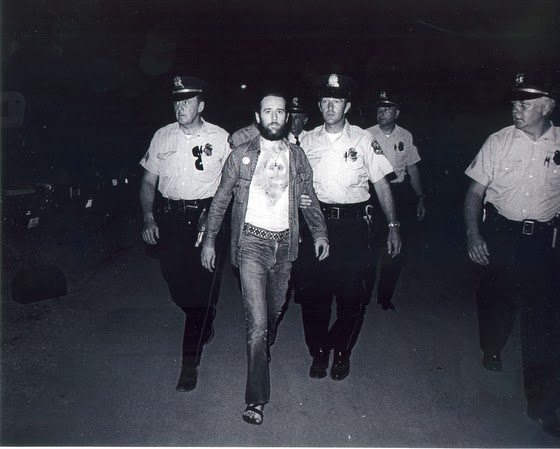
George Carlin being arrested for "Seven Words You Can Never Say on Television", 1972
International Women's Day

Margaret Hamilton, who developed on-board flight software for the Apollo space program, along side the printed code.
Slavoj Žižek, New Statesman, 2014
Now, when we are all in a state of shock after the killing spree in the Charlie Hebdo offices, it is the right moment to gather the courage to think. We should, of course, unambiguously condemn the killings as an attack on the very substance our freedoms, and condemn them without any hidden caveats (in the style of "Charlie Hebdo was nonetheless provoking and humiliating the Muslims too much"). But such pathos of universal solidarity is not enough – we should think further.
Such thinking has nothing whatsoever to do with the cheap relativisation of the crime (the mantra of "who are we in the West, perpetrators of terrible massacres in the Third World, to condemn such acts"). It has even less to do with the pathological fear of many Western liberal Leftists to be guilty of Islamophobia. For these false Leftists, any critique of Islam is denounced as an expression of Western Islamophobia; Salman Rushdie was denounced for unnecessarily provoking Muslims and thus (partially, at least) responsible for the fatwa condemning him to death, etc. The result of such stance is what one can expect in such cases: the more the Western liberal Leftists probe into their guilt, the more they are accused by Muslim fundamentalists of being hypocrites who try to conceal their hatred of Islam. This constellation perfectly reproduces the paradox of the superego: the more you obey what the Other demands of you, the guiltier you are. It is as if the more you tolerate Islam, the stronger its pressure on you will be . . .
This is why I also find insufficient calls for moderation along the lines of Simon Jenkins's claim (in The Guardian on January 7) that our task is “not to overreact, not to over-publicise the aftermath. It is to treat each event as a passing accident of horror” – the attack on Charlie Hebdo was not a mere “passing accident of horror”. it followed a precise religious and political agenda and was as such clearly part of a much larger pattern. Of course we should not overreact, if by this is meant succumbing to blind Islamophobia – but we should ruthlessly analyse this pattern.
What is much more needed than the demonisation of the terrorists into heroic suicidal fanatics is a debunking of this demonic myth. Long ago Friedrich Nietzsche perceived how Western civilisation was moving in the direction of the Last Man, an apathetic creature with no great passion or commitment. Unable to dream, tired of life, he takes no risks, seeking only comfort and security, an expression of tolerance with one another: “A little poison now and then: that makes for pleasant dreams. And much poison at the end, for a pleasant death. They have their little pleasures for the day, and their little pleasures for the night, but they have a regard for health. ‘We have discovered happiness,’ - say the Last Men, and they blink.”
It effectively may appear that the split between the permissive First World and the fundamentalist reaction to it runs more and more along the lines of the opposition between leading a long satisfying life full of material and cultural wealth, and dedicating one's life to some transcendent Cause. Is this antagonism not the one between what Nietzsche called "passive" and "active" nihilism? We in the West are the Nietzschean Last Men, immersed in stupid daily pleasures, while the Muslim radicals are ready to risk everything, engaged in the struggle up to their self-destruction. William Butler Yeats’ “Second Coming” seems perfectly to render our present predicament: “The best lack all conviction, while the worst are full of passionate intensity.” This is an excellent description of the current split between anemic liberals and impassioned fundamentalists. “The best” are no longer able fully to engage, while “the worst” engage in racist, religious, sexist fanaticism.
However, do the terrorist fundamentalists really fit this description? What they obviously lack is a feature that is easy to discern in all authentic fundamentalists, from Tibetan Buddhists to the Amish in the US: the absence of resentment and envy, the deep indifference towards the non-believers’ way of life. If today’s so-called fundamentalists really believe they have found their way to Truth, why should they feel threatened by non-believers, why should they envy them? When a Buddhist encounters a Western hedonist, he hardly condemns. He just benevolently notes that the hedonist’s search for happiness is self-defeating. In contrast to true fundamentalists, the terrorist pseudo-fundamentalists are deeply bothered, intrigued, fascinated, by the sinful life of the non-believers. One can feel that, in fighting the sinful other, they are fighting their own temptation.
It is here that Yeats’ diagnosis falls short of the present predicament: the passionate intensity of the terrorists bears witness to a lack of true conviction. How fragile the belief of a Muslim must be if he feels threatened by a stupid caricature in a weekly satirical newspaper? The fundamentalist Islamic terror is not grounded in the terrorists’ conviction of their superiority and in their desire to safeguard their cultural-religious identity from the onslaught of global consumerist civilization. The problem with fundamentalists is not that we consider them inferior to us, but, rather, that they themselves secretly consider themselves inferior. This is why our condescending politically correct assurances that we feel no superiority towards them only makes them more furious and feeds their resentment. The problem is not cultural difference (their effort to preserve their identity), but the opposite fact that the fundamentalists are already like us, that, secretly, they have already internalized our standards and measure themselves by them. Paradoxically, what the fundamentalists really lack is precisely a dose of that true ‘racist’ conviction of their own superiority.
The recent vicissitudes of Muslim fundamentalism confirm Walter Benjamin's old insight that “every rise of Fascism bears witness to a failed revolution”: the rise of Fascism is the Left’s failure, but simultaneously a proof that there was a revolutionary potential, dissatisfaction, which the Left was not able to mobilize. And does the same not hold for today’s so-called “Islamo-Fascism”? Is the rise of radical Islamism not exactly correlative to the disappearance of the secular Left in Muslim countries? When, back in the Spring of 2009, Taliban took over the Swat valley in Pakistan, New York Times reported that they engineered "a class revolt that exploits profound fissures between a small group of wealthy landlords and their landless tenants". If, however, by “taking advantage” of the farmers’ plight, The Taliban are “raising alarm about the risks to Pakistan, which remains largely feudal,” what prevents liberal democrats in Pakistan as well as the US to similarly “take advantage” of this plight and try to help the landless farmers? The sad implication of this fact is that the feudal forces in Pakistan are the “natural ally” of the liberal democracy…
So what about the core values of liberalism: freedom, equality, etc.? The paradox is that liberalism itself is not strong enough to save them against the fundamentalist onslaught. Fundamentalism is a reaction – a false, mystifying, reaction, of course - against a real flaw of liberalism, and this is why it is again and again generated by liberalism. Left to itself, liberalism will slowly undermine itself – the only thing that can save its core values is a renewed Left. In order for this key legacy to survive, liberalism needs the brotherly help of the radical Left. THIS is the only way to defeat fundamentalism, to sweep the ground under its feet.
To think in response to the Paris killings means to drop the smug self-satisfaction of a permissive liberal and to accept that the conflict between liberal permissiveness and fundamentalism is ultimately a false conflict – a vicious cycle of two poles generating and presupposing each other. What Max Horkheimer had said about Fascism and capitalism already back in 1930s - those who do not want to talk critically about capitalism should also keep quiet about Fascism - should also be applied to today’s fundamentalism: those who do not want to talk critically about liberal democracy should also keep quiet about religious fundamentalism.
Jean Baudrillard ~ The Pyres of Autumn, 2006
Fifteen hundred cars had to burn in a single night and then, on a descending scale, nine hundred, five hundred, two hundred, for the daily ‘norm’ to be reached again, and people to realize that ninety cars on average are torched every night in this gentle France of ours. A sort of eternal flame, like that under the Arc de Triomphe, burning in honour of the Unknown Immigrant. Known now, after a lacerating process of revision—but still in trompe l’oeil.
The French exception is no more, the ‘French model’ collapsing before our eyes. But the French can reassure themselves that it is not just theirs but the whole Western model which is disintegrating; and not just under external assault—acts of terrorism, Africans storming the barbed wire at Melilla—but also from within. The first conclusion to be drawn from the autumn riots annuls all pious official homilies. A society which is itself disintegrating has no chance of integrating its immigrants, who are at once the products and savage analysts of its decay. The harsh reality is that the rest of us, too, are faced with a crisis of identity and disinheritance; the fissures of the banlieues are merely symptoms of the dissociation of a society at odds with itself. As Hélé Béji has remarked, the social question of immigration is only a starker illustration of the European’s exile within his own society. Europe’s citizens are no longer integrated into ‘European’—or ‘French’—values, and can only try to palm them off on others.
‘Integration’ is the official line. But integration into what? The sorry spectacle of ‘successful’ integration—into a banalized, technized, upholstered way of life, carefully shielded from self-questioning—is that of we French ourselves. To talk of ‘integration’ in the name of some indefinable notion of France is merely to signal its lack.
It is French—more broadly, European—society which, by its very process of socialization, day by day secretes the relentless discrimination of which immigrants are the designated victims, though not the only ones. This is the change on the unequal bargain of ‘democracy’. This society faces a far harder test than any external threat: that of its own absence, its loss of reality. Soon it will be defined solely by the foreign bodies that haunt its periphery: those it has expelled, but who are now ejecting it from itself. It is their violent interpellation that reveals what has been coming apart, and so offers the possibility for awareness. If French—if European—society were to succeed in ‘integrating’ them, it would in its own eyes cease to exist.
Yet French or European discrimination is only the micro-model of a worldwide divide which, under the ironical sign of globalization, is bringing two irreconcilable universes face to face. The same analysis can be reprised at global level. International terrorism is but a symptom of the split personality of a world power at odds with itself. As to finding a solution, the same delusion applies at every level, from the banlieues to the House of Islam: the fantasy that raising the rest of the world to Western living standards will settle matters. The fracture is far deeper than that. Even if the assembled Western powers really wanted to close it—which there is every reason to doubt—they could not. The very mechanisms of their own survival and superiority would prevent them; mechanisms which, through all the pious talk of universal values, serve only to reinforce Western power and so to foment the threat of a coalition of forces that dream of destroying it.
But France, or Europe, no longer has the initiative. It no longer controls events, as it did for centuries, but is at the mercy of a succession of unforeseeable blow-backs. Those who deplore the ideological bankruptcy of the West should recall that ‘God smiles at those he sees denouncing evils of which they are the cause’. If the explosion of the banlieues is thus directly linked to the world situation, it is also—a fact which is strangely never discussed—connected to another recent episode, solicitously occluded and misrepresented in just the same way: the No in the EU Constitutional referendum. Those who voted No without really knowing why—perhaps simply because they did not wish to play the game into which they had so often been trapped; because they too refused to be integrated into the wondrous Yes of a ‘ready for occupancy’ Europe—their No was the voice of those jettisoned by the system of representation: exiles too, like the immigrants themselves, from the process of socialization. There was the same recklessness, the same irresponsibility in the act of scuppering the EU as in the young immigrants’ burning of their own neighbourhoods, their own schools; like the blacks in Watts and Detroit in the 1960s. Many now live, culturally and politically, as immigrants in a country which can no longer offer them a definition of national belonging. They are disaffiliated, as Robert Castel has put it.
But it is a short step from disaffiliation to desafío—defiance. All the excluded, the disaffiliated, whether from the banlieues, immigrants or ‘native-born’, at one point or another turn their disaffiliation into defiance and go onto the offensive. It is their only way to stop being humiliated, discarded or taken in hand. In the wake of the November fires, mainstream political sociology spoke of integration, employment, security. I am not so sure that the rioters want to be reintegrated on these lines. Perhaps they consider the French way of life with the same condescension or indifference with which it views theirs. Perhaps they prefer to see cars burning than to dream of one day driving them. Perhaps their reaction to an over-calculated solicitude would instinctively be the same as to exclusion and repression.
The superiority of Western culture is sustained only by the desire of the rest of the world to join it. When there is the least sign of refusal, the slightest ebbing of that desire, the West loses its seductive appeal in its own eyes. Today it is precisely the ‘best’ it has to offer—cars, schools, shopping centres—that are torched and ransacked. Even nursery schools: the very tools through which the car-burners were to be integrated and mothered. ‘Screw your mother’ might be their organizing slogan. And the more there are attempts to ‘mother’ them, the more they will. Of course, nothing will prevent our enlightened politicians and intellectuals from considering the autumn riots as minor incidents on the road to a democratic reconciliation of all cultures. Everything indicates that on the contrary, they are successive phases of a revolt whose end is not in sight.
"It may sound pompous, but I'd rather die standing than live on my knees." ~ Stéphane Charbonnier
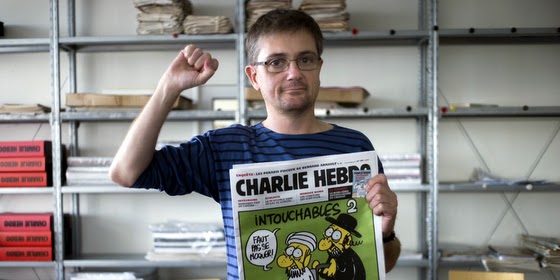
RIP Stuart Hall. A hero of mine at university. I had the great pleasure of meeting him once at a conference in the mid 90s. I did my master's degree in Culture & Media Studies because of him.
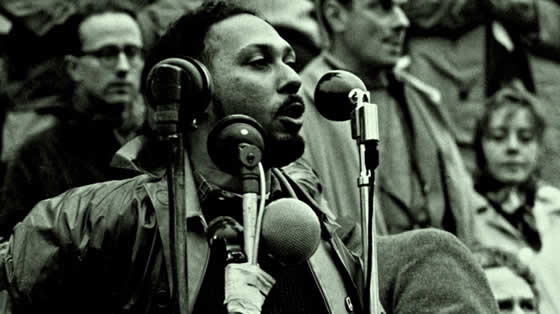
Martin Luther King's I Have A Dream Speech, delivered 50 years ago today on 28 August 1963
"I am happy to join with you today in what will go down in history as the greatest demonstration for freedom in the history of our nation.
Five score years ago, a great American, in whose symbolic shadow we stand signed the Emancipation Proclamation. This momentous decree came as a great beacon light of hope to millions of Negro slaves who had been seared in the flames of withering injustice. It came as a joyous daybreak to end the long night of captivity.
But one hundred years later, we must face the tragic fact that the Negro is still not free. One hundred years later, the life of the Negro is still sadly crippled by the manacles of segregation and the chains of discrimination. One hundred years later, the Negro lives on a lonely island of poverty in the midst of a vast ocean of material prosperity. One hundred years later, the Negro is still languishing in the corners of American society and finds himself an exile in his own land. So we have come here today to dramatize an appalling condition.
In a sense we have come to our nation's capital to cash a check. When the architects of our republic wrote the magnificent words of the Constitution and the Declaration of Independence, they were signing a promissory note to which every American was to fall heir. This note was a promise that all men would be guaranteed the inalienable rights of life, liberty, and the pursuit of happiness.
It is obvious today that America has defaulted on this promissory note insofar as her citizens of color are concerned. Instead of honoring this sacred obligation, America has given the Negro people a bad check which has come back marked "insufficient funds." But we refuse to believe that the bank of justice is bankrupt. We refuse to believe that there are insufficient funds in the great vaults of opportunity of this nation. So we have come to cash this check -- a check that will give us upon demand the riches of freedom and the security of justice. We have also come to this hallowed spot to remind America of the fierce urgency of now.
This is no time to engage in the luxury of cooling off or to take the tranquilizing drug of gradualism. Now is the time to rise from the dark and desolate valley of segregation to the sunlit path of racial justice. Now is the time to open the doors of opportunity to all of God's children. Now is the time to lift our nation from the quicksands of racial injustice to the solid rock of brotherhood.
It would be fatal for the nation to overlook the urgency of the moment and to underestimate the determination of the Negro. This sweltering summer of the Negro's legitimate discontent will not pass until there is an invigorating autumn of freedom and equality. Nineteen sixty-three is not an end, but a beginning. Those who hope that the Negro needed to blow off steam and will now be content will have a rude awakening if the nation returns to business as usual. There will be neither rest nor tranquility in America until the Negro is granted his citizenship rights. The whirlwinds of revolt will continue to shake the foundations of our nation until the bright day of justice emerges.
But there is something that I must say to my people who stand on the warm threshold which leads into the palace of justice. In the process of gaining our rightful place we must not be guilty of wrongful deeds. Let us not seek to satisfy our thirst for freedom by drinking from the cup of bitterness and hatred.
We must forever conduct our struggle on the high plane of dignity and discipline. We must not allow our creative protest to degenerate into physical violence. Again and again we must rise to the majestic heights of meeting physical force with soul force. The marvelous new militancy which has engulfed the Negro community must not lead us to distrust of all white people, for many of our white brothers, as evidenced by their presence here today, have come to realize that their destiny is tied up with our destiny and their freedom is inextricably bound to our freedom. We cannot walk alone.
And as we walk, we must make the pledge that we shall march ahead. We cannot turn back. There are those who are asking the devotees of civil rights, "When will you be satisfied?" We can never be satisfied as long as our bodies, heavy with the fatigue of travel, cannot gain lodging in the motels of the highways and the hotels of the cities. We cannot be satisfied as long as the Negro's basic mobility is from a smaller ghetto to a larger one. We can never be satisfied as long as a Negro in Mississippi cannot vote and a Negro in New York believes he has nothing for which to vote. No, no, we are not satisfied, and we will not be satisfied until justice rolls down like waters and righteousness like a mighty stream.
I am not unmindful that some of you have come here out of great trials and tribulations. Some of you have come fresh from narrow cells. Some of you have come from areas where your quest for freedom left you battered by the storms of persecution and staggered by the winds of police brutality. You have been the veterans of creative suffering. Continue to work with the faith that unearned suffering is redemptive.
Go back to Mississippi, go back to Alabama, go back to Georgia, go back to Louisiana, go back to the slums and ghettos of our northern cities, knowing that somehow this situation can and will be changed. Let us not wallow in the valley of despair.
I say to you today, my friends, that in spite of the difficulties and frustrations of the moment, I still have a dream. It is a dream deeply rooted in the American dream.
I have a dream that one day this nation will rise up and live out the true meaning of its creed: "We hold these truths to be self-evident: that all men are created equal."
I have a dream that one day on the red hills of Georgia the sons of former slaves and the sons of former slave owners will be able to sit down together at a table of brotherhood.
I have a dream that one day even the state of Mississippi, a desert state, sweltering with the heat of injustice and oppression, will be transformed into an oasis of freedom and justice.
I have a dream that my four children will one day live in a nation where they will not be judged by the color of their skin but by the content of their character.
I have a dream today.
I have a dream that one day the state of Alabama, whose governor's lips are presently dripping with the words of interposition and nullification, will be transformed into a situation where little black boys and black girls will be able to join hands with little white boys and white girls and walk together as sisters and brothers.
I have a dream today.
I have a dream that one day every valley shall be exalted, every hill and mountain shall be made low, the rough places will be made plain, and the crooked places will be made straight, and the glory of the Lord shall be revealed, and all flesh shall see it together.
This is our hope. This is the faith with which I return to the South. With this faith we will be able to hew out of the mountain of despair a stone of hope. With this faith we will be able to transform the jangling discords of our nation into a beautiful symphony of brotherhood. With this faith we will be able to work together, to pray together, to struggle together, to go to jail together, to stand up for freedom together, knowing that we will be free one day.
This will be the day when all of God's children will be able to sing with a new meaning, "My country, 'tis of thee, sweet land of liberty, of thee I sing. Land where my fathers died, land of the pilgrim's pride, from every mountainside, let freedom ring."
And if America is to be a great nation this must become true. So let freedom ring from the prodigious hilltops of New Hampshire. Let freedom ring from the mighty mountains of New York. Let freedom ring from the heightening Alleghenies of Pennsylvania!
Let freedom ring from the snow-capped Rockies of Colorado!
Let freedom ring from the curvaceous slopes of California!
But not only that; let freedom ring from Stone Mountain of Georgia!
Let freedom ring from Lookout Mountain of Tennessee!
Let freedom ring from every hill and molehill of Mississippi. From every mountainside, let freedom ring.
And when this happens, when we allow freedom to ring, when we let it ring from every village and every hamlet, from every state and every city, we will be able to speed up that day when all of God's children, black men and white men, Jews and Gentiles, Protestants and Catholics, will be able to join hands and sing in the words of the old Negro spiritual, "Free at last! free at last! thank God Almighty, we are free at last!"
Information is power. But like all power, there are those who want to keep it for themselves. The world’s entire scientific and cultural heritage, published over centuries in books and journals, is increasingly being digitized and locked up by a handful of private corporations. Want to read the papers featuring the most famous results of the sciences? You’ll need to send enormous amounts to publishers like Reed Elsevier.
There are those struggling to change this. The Open Access Movement has fought valiantly to ensure that scientists do not sign their copyrights away but instead ensure their work is published on the Internet, under terms that allow anyone to access it. But even under the best scenarios, their work will only apply to things published in the future. Everything up until now will have been lost.
That is too high a price to pay. Forcing academics to pay money to read the work of their colleagues? Scanning entire libraries but only allowing the folks at Google to read them? Providing scientific articles to those at elite universities in the First World, but not to children in the Global South? It’s outrageous and unacceptable.
“I agree,” many say, “but what can we do? The companies hold the copyrights, they make enormous amounts of money by charging for access, and it’s perfectly legal — there’s nothing we can do to stop them.” But there is something we can, something that’s already being done: we can fight back.
Those with access to these resources — students, librarians, scientists — you have been given a privilege. You get to feed at this banquet of knowledge while the rest of the world is locked out. But you need not — indeed, morally, you cannot — keep this privilege for yourselves. You have a duty to share it with the world. And you have: trading passwords with colleagues, filling download requests for friends.
Meanwhile, those who have been locked out are not standing idly by. You have been sneaking through holes and climbing over fences, liberating the information locked up by the publishers and sharing them with your friends.
But all of this action goes on in the dark, hidden underground. It’s called stealing or piracy, as if sharing a wealth of knowledge were the moral equivalent of plundering a ship and murdering its crew. But sharing isn’t immoral — it’s a moral imperative. Only those blinded by greed would refuse to let a friend make a copy.
Large corporations, of course, are blinded by greed. The laws under which they operate require it — their shareholders would revolt at anything less. And the politicians they have bought off back them, passing laws giving them the exclusive power to decide who can make copies.
There is no justice in following unjust laws. It’s time to come into the light and, in the grand tradition of civil disobedience, declare our opposition to this private theft of public culture.
We need to take information, wherever it is stored, make our copies and share them with the world. We need to take stuff that's out of copyright and add it to the archive. We need to buy secret databases and put them on the Web. We need to download scientific journals and upload them to file sharing networks. We need to fight for Guerilla Open Access.
With enough of us, around the world, we’ll not just send a strong message opposing the privatization of knowledge — we’ll make it a thing of the past. Will you join us?
Aaron Swartz
July 2008, Eremo, Italy
Do the left wing react the same way to some austerity measures as some environmentalists do to GMO farming? Are measures such as labour law reforms eschewed because the left wing have the same paranoid concerns about the influence of big business as the environmentalists? Should politicians and economists adopt a more evidence base approach to social and economic changes? Is an evidence based approach even possible in the emotionally charged popularity competition that is politics? Do ideologically driven politicians even care about evidence?