“The political merchandisers appeal only to the weaknesses of voters, never to their potential strength. They make no attempt to educate the masses into becoming fit for self-government; they are content merely to manipulate and exploit them. For this purpose all the resources of psychology and the social sciences are mobilized and set to work. Carefully selected samples of the electorate are given "interviews in depth." These interviews in depth reveal the unconscious fears and wishes most prevalent in a given society at the time of an election. Phrases and images aimed at allaying or, if necessary, enhancing these fears, at satisfying these wishes, at least symbolically, are then chosen by the experts, tried out on readers and audiences, changed or improved in the light of the information thus obtained. After which the political campaign is ready for the mass communicators. All that is now needed is money and a candidate who can be coached to look "sincere." Under the new dispensation, political principles and plans for specific action have come to lose most of their importance. The personality of the candidate and the way he is projected by the advertising experts are the things that really matter.
In one way or another, as vigorous he-man or kindly father, the candidate must be glamorous. He must also be an entertainer who never bores his audience. Inured to television and radio, that audience is accustomed to being distracted and does not like to be asked to concentrate or make a prolonged intellectual effort. All speeches by the entertainer-candidate must therefore be short and snappy. The great issues of the day must be dealt with in five minutes at the most -- and preferably (since the audience will be eager to pass on to something a little livelier than inflation or the H-bomb) in sixty seconds flat. The nature of oratory is such that there has always been a tendency among politicians and clergymen to over-simplify complex issues. From a pulpit or a platform even the most conscientious of speakers finds it very difficult to tell the whole truth. The methods now being used to merchandise the political candidate as though he were a deodorant positively guarantee the electorate against ever hearing the truth about anything.” ~ Aldous Huxley, Brave New World Revisited, 1958
“I have a foreboding of an America in my children's or grandchildren's time - when the United States is a service and information economy; when nearly all the manufacturing industries have slipped away to other countries; when awesome technological powers are in the hands of a very few, and no one representing the public interest can even grasp the issues; when the people have lost the ability to set their own agendas or knowledgeably question those in authority; when, clutching our crystals and nervously consulting our horoscopes, our critical faculties in decline, unable to distinguish between what feels good and what's true, we slide, almost without noticing, back into superstition and darkness. The dumbing down of American is most evident in the slow decay of substantive content in the enormously influential media, the 30 second sound bites (now down to 10 seconds or less), lowest common denominator programming, credulous presentations on pseudoscience and superstition, but especially a kind of celebration of ignorance” ~ Carl Sagan, The Demon-Haunted World: Science as a Candle, 1975

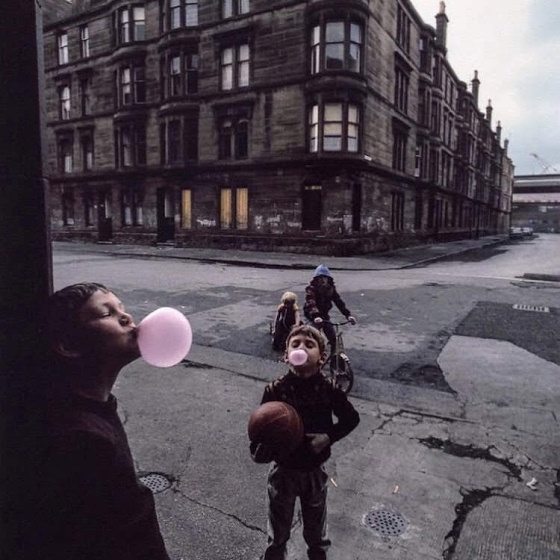
Ella 'Tish' Murtha, Youth Unemployment, 1981

Unknown photographer

Thomas Blower, Hattersley, Greater Manchester, 1970s.

Martha Cooper, A boy jumping onto a mattress from a fire escape. Lower East Side., 1978-1980
Bo Diddley, Who Do You Love
I walk 47 miles of barbed wire I use a cobra-snake for a necktie I got a brand new house on the roadside Made from rattlesnake hide I got a brand new chimney made on top Made out of a human skull Now come on take a walk with me, Arlene And tell me, who do you love?
Page 74 of 156