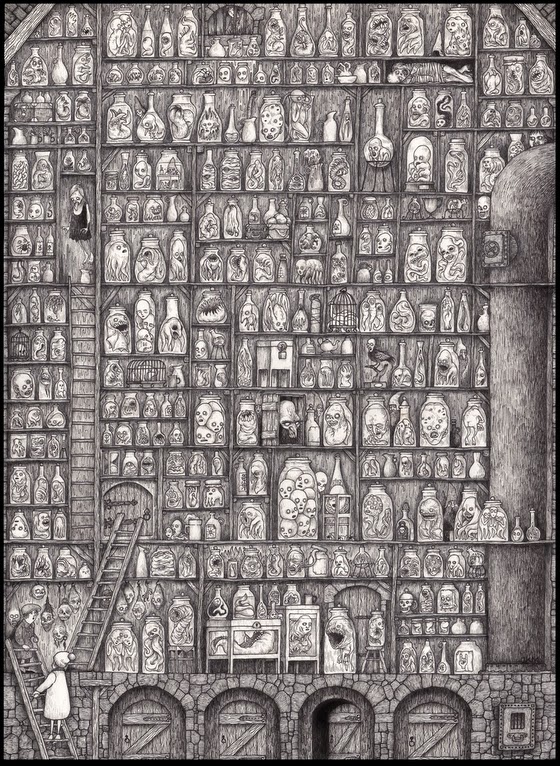
Rory Kurtz, Rocky Passages, Broken Promises, 2011
Self-pity by D. H. Lawrence I never saw a wild thing sorry for itself. A small bird will drop frozen dead from a bough without ever having felt sorry for itself.
The Solar Anus by Georges Bataille
It is clear that the world is purely parodic, in other words, that each thing seen is the parody of another, or is the same thing in a deceptive form.
Ever since sentences started to circulate in brains devoted to reflection, an effort at total identification has been made, because with the aid of a copula each sentence ties one thing to another; all things would be visibly connected if one could discover at a single glance and in its totality the tracings of Ariadne’s thread leading thought into its own labyrinth.
But the copula of terms is no less irritating than the copulation of bodies. And when I scream I AM THE SUN an integral erection results, because the verb to be is the vehicle of amorous frenzy.
Everyone is aware that life is parodic and that it lacks an interpretation. Thus lead is the parody of gold. Air is the parody of water. The brain is the parody of the equator. Coitus is the parody of crime.
Gold, water, the equator, or crime can each be put forward as the principle of things.
And if the origin of things is not like the ground of the planet that seems to be the base, but like the circular movement that the planet describes around a mobile center, then a car, a clock, or a sewing machine could equally be accepted as the generative principle.
The two primary motions are rotation and sexual movement, whose combination is expressed by the locomotive’s wheels and pistons.
These two motions are reciprocally transformed, the one into the other.
Thus one notes that the earth, by turning, makes animals and men have coitus, and (because the result is as much the cause as that which provokes it) that animals and men make the earth turn by having coitus.
It is the mechanical combination or transformation of these movements that the alchemists sought as the philosopher’s stone.
It is through the use of this magically valued combination that one can determine the present position of men in the midst of the elements.
An abandoned shoe, a rotten tooth, a snub nose, the cook spitting in the soup of his masters are to love what a battle flag is to nationality.
An umbrella, a sexagenarian, a seminarian, the smell of rotten eggs, the hollow eyes of judges are the roots that nourish love.
A dog devouring the stomach of a goose, a drunken vomiting woman, a slobbering accountant, a jar of mustard represent the confusion that serves as the vehicle of love.
A man who finds himself among others is irritated because he does not know why he is not one of the others.
In bed next to a girl he loves, he forgets that he does not know why he is himself instead of the body he touches.
Without knowing it, he suffers from the mental darkness that keeps him from screaming that he himself is the girl who forgets his presence while shuddering in his arms.
Love or infantile rage, or a provincial dowager’s vanity, or clerical pornography, or the diamond of a soprano bewilder individuals forgotten in dusty apartments.
They can very well try to find each other; they will never find anything but parodic images, and they will fall asleep as empty as mirrors.
The absent and inert girl hanging dreamless from my arms is no more foreign to me than the door or window through which I can look or pass.
I rediscover indifference (allowing her to leave me) when I fall asleep, through an inability to love what happens.
It is impossible for her to know whom she will discover when I hold her, because she obstinately attains a complete forgetting.
The planetary systems that turn in space like rapid disks, and whose centers also move, describing an infinitely larger circle, only move away continuously from their own position in order to return it, completing their rotation.
Movement is a figure of love, incapable of stopping at a particular being, and rapidly passing from one to another.
But the forgetting that determines it in this way is only a subterfuge of memory.
A man gets up as brusquely as a specter in a coffin and falls in the same way.
He gets up a few hours later and then he falls again, and the same thing happens every day; this great coitus with the celestial atmosphere is regulated by the terrestrial rotation around the sun.
Thus even though terrestrial life moves to the rhythm of this rotation, the image of this movement is not turning earth, but the male shaft penetrating the female and almost entirely emerging, in order to reenter.
Love and life appear to be separate only because everything on earth is broken apart by vibrations of various amplitudes and durations.
However, there are no vibrations that are not conjugated with a continuous circular movement; in the same way, a locomotive rolling on the surface of the earth is the image of continuous metamorphosis.
Beings only die to be born, in the manner of phalluses that leave bodies in order to enter them.
Plants rise in the direction of the sun and then collapse in the direction of the ground.
Trees bristle the ground with a vast quantity of flowered shafts raised up to the sun.
The trees that forcefully soar end up burned by lightning, chopped down, or uprooted. Returned to the ground, they come back up in another form.
But their polymorphous coitus is a function of uniform terrestrial rotation.
The simplest image of organic life united with rotation is the tide. From the movement of the sea, uniform coitus of the earth with the moon, comes the polymorphous and organic coitus of the earth with the sun.
But the first form of solar love is a cloud raised up over the liquid element. The erotic cloud sometimes becomes a storm and falls back to earth in the form of rain, while lightning staves in the layers of the atmosphere.
The rain is soon raised up again in the form of an immobile plant.
Animal life comes entirely from the movement of the seas and, inside bodies, life continues to come from salt water.
The sea, then, has played the role of the female organ that liquefies under the excitation of the penis.
The sea continuously jerks off.
Solid elements, contained and brewed in water animated by erotic movement, shoot out in the form of flying fish.
The erection and the sun scandalize, in the same way as the cadaver and the darkness of cellars.
Vegetation is uniformly directed towards the sun; human beings, on the other hand, even though phalloid like trees, in opposition to other animals, necessarily avert their eyes.
Human eyes tolerate neither sun, coitus, cadavers, nor obscurity, but with different reactions.
When my face is flushed with blood, it becomes red and obscene.
It betrays at the same time, through morbid reflexes, a bloody erection and a demanding thirst for indecency and criminal debauchery.
For that reason I am not afraid to affirm that my face is a scandal and that my passions are expressed only by the JESUVE.
The terrestrial globe is covered with volcanoes, which serve as its anus.
Although this globe eats nothing, it often violently ejects the contents of its entrails.
Those contents shoot out with a racket and fall back, streaming down the sides of the Jesuve, spreading death and terror everywhere.
In fact, the erotic movements of the ground are not fertile like those of the water, but they are far more rapid.
The earth sometimes jerks off in a frenzy, and everything collapses on its surface.
The Jesuve is thus the image of an erotic movement that burglarizes the ideas contained in the mind, giving them the force a scandalous eruption.
This eruptive force accumulates in those who are necessarily situated below.
Communist workers appear to the bourgeois to be as ugly and dirty as hairy sexual organs, or lower parts; sooner or later there will be a scandalous eruption in the course of which the asexual noble heads of the bourgeois will be chopped off.
The erotic revolutionary and volcanic deflagrations antagonize the heavens.
As in the case of violent love, they take place beyond the constraints of fecundity.
In opposition to celestial fertility there are terrestrial disasters, the image of terrestrial love without condition, erection without escape and without rule, scandal, and terror.
Love then screams in my own throat; I am the Jesuve, the filthy parody of the torrid and blinding sun.
I want to have my throat slashed while violating the girl to whom I will have been able to say: you are the night.
The Sun exclusively loves the Night and directs its luminous violence, its ignoble shaft, toward the earth, but finds itself incapable of reaching the gaze or the night, even though the nocturnal terrestrial expanses head continuously toward the indecency of the solar ray.
The solar annulus is the intact anus of her body at eighteen years to which nothing sufficiently blinding can be compared except the sun, even though the anus is night.
The Library of Babel by Jorge Luis Borges
By this art you may contemplate the variations of the 23 letters...
The Anatomy of Melancholy, part 2, sect. II, mem. IV
The universe (which others call the Library) is composed of an indefinite and perhaps infinite number of hexagonal galleries, with vast air shafts between, surrounded by very low railings. From any of the hexagons one can see, interminably, the upper and lower floors. The distribution of the galleries is invariable. Twenty shelves, five long shelves per side, cover all the sides except two; their height, which is the distance from floor to ceiling, scarcely exceeds that of a normal bookcase. One of the free sides leads to a narrow hallway which opens onto another gallery, identical to the first and to all the rest. To the left and right of the hallway there are two very small closets. In the first, one may sleep standing up; in the other, satisfy one's fecal necessities. Also through here passes a spiral stairway, which sinks abysmally and soars upwards to remote distances. In the hallway there is a mirror which faithfully duplicates all appearances. Men usually infer from this mirror that the Library is not infinite (if it were, why this illusory duplication?); I prefer to dream that its polished surfaces represent and promise the infinite ... Light is provided by some spherical fruit which bear the name of lamps. There are two, transversally placed, in each hexagon. The light they emit is insufficient, incessant. Like all men of the Library, I have traveled in my youth; I have wandered in search of a book, perhaps the catalogue of catalogues; now that my eyes can hardly decipher what I write, I am preparing to die just a few leagues from the hexagon in which I was born. Once I am dead, there will be no lack of pious hands to throw me over the railing; my grave will be the fathomless air; my body will sink endlessly and decay and dissolve in the wind generated by the fall, which is infinite. I say that the Library is unending. The idealists argue that the hexagonal rooms are a necessary from of absolute space or, at least, of our intuition of space. They reason that a triangular or pentagonal room is inconceivable. (The mystics claim that their ecstasy reveals to them a circular chamber containing a great circular book, whose spine is continuous and which follows the complete circle of the walls; but their testimony is suspect; their words, obscure. This cyclical book is God.) Let it suffice now for me to repeat the classic dictum: The Library is a sphere whose exact center is any one of its hexagons and whose circumference is inaccessible.
There are five shelves for each of the hexagon's walls; each shelf contains thirty-five books of uniform format; each book is of four hundred and ten pages; each page, of forty lines, each line, of some eighty letters which are black in color. There are also letters on the spine of each book; these letters do not indicate or prefigure what the pages will say. I know that this incoherence at one time seemed mysterious. Before summarizing the solution (whose discovery, in spite of its tragic projections, is perhaps the capital fact in history) I wish to recall a few axioms.
First: The Library exists ab aeterno. This truth, whose immediate corollary is the future eternity of the world, cannot be placed in doubt by any reasonable mind. Man, the imperfect librarian, may be the product of chance or of malevolent demiurgi; the universe, with its elegant endowment of shelves, of enigmatical volumes, of inexhaustible stairways for the traveler and latrines for the seated librarian, can only be the work of a god. To perceive the distance between the divine and the human, it is enough to compare these crude wavering symbols which my fallible hand scrawls on the cover of a book, with the organic letters inside: punctual, delicate, perfectly black, inimitably symmetrical.
Second: The orthographical symbols are twenty-five in number. This finding made it possible, three hundred years ago, to formulate a general theory of the Library and solve satisfactorily the problem which no conjecture had deciphered: the formless and chaotic nature of almost all the books. One which my father saw in a hexagon on circuit fifteen ninety-four was made up of the letters MCV, perversely repeated from the first line to the last. Another (very much consulted in this area) is a mere labyrinth of letters, but the next-to-last page says Oh time thy pyramids. This much is already known: for every sensible line of straightforward statement, there are leagues of senseless cacophonies, verbal jumbles and incoherences. (I know of an uncouth region whose librarians repudiate the vain and superstitious custom of finding a meaning in books and equate it with that of finding a meaning in dreams or in the chaotic lines of one's palm ... They admit that the inventors of this writing imitated the twenty-five natural symbols, but maintain that this application is accidental and that the books signify nothing in themselves. This dictum, we shall see, is not entirely fallacious.)
For a long time it was believed that these impenetrable books corresponded to past or remote languages. It is true that the most ancient men, the first librarians, used a language quite different from the one we now speak; it is true that a few miles to the right the tongue is dialectical and that ninety floors farther up, it is incomprehensible. All this, I repeat, is true, but four hundred and ten pages of inalterable MCV's cannot correspond to any language, no matter how dialectical or rudimentary it may be. Some insinuated that each letter could influence the following one and that the value of MCV in the third line of page 71 was not the one the same series may have in another position on another page, but this vague thesis did not prevail. Others thought of cryptographs; generally, this conjecture has been accepted, though not in the sense in which it was formulated by its originators.
Five hundred years ago, the chief of an upper hexagon came upon a book as confusing as the others, but which had nearly two pages of homogeneous lines. He showed his find to a wandering decoder who told him the lines were written in Portuguese; others said they were Yiddish. Within a century, the language was established: a Samoyedic Lithuanian dialect of Guarani, with classical Arabian inflections. The content was also deciphered: some notions of combinative analysis, illustrated with examples of variations with unlimited repetition. These examples made it possible for a librarian of genius to discover the fundamental law of the Library. This thinker observed that all the books, no matter how diverse they might be, are made up of the same elements: the space, the period, the comma, the twenty-two letters of the alphabet. He also alleged a fact which travelers have confirmed: In the vast Library there are no two identical books. From these two incontrovertible premises he deduced that the Library is total and that its shelves register all the possible combinations of the twenty-odd orthographical symbols (a number which, though extremely vast, is not infinite): Everything: the minutely detailed history of the future, the archangels' autobiographies, the faithful catalogues of the Library, thousands and thousands of false catalogues, the demonstration of the fallacy of those catalogues, the demonstration of the fallacy of the true catalogue, the Gnostic gospel of Basilides, the commentary on that gospel, the commentary on the commentary on that gospel, the true story of your death, the translation of every book in all languages, the interpolations of every book in all books.
When it was proclaimed that the Library contained all books, the first impression was one of extravagant happiness. All men felt themselves to be the masters of an intact and secret treasure. There was no personal or world problem whose eloquent solution did not exist in some hexagon. The universe was justified, the universe suddenly usurped the unlimited dimensions of hope. At that time a great deal was said about the Vindications: books of apology and prophecy which vindicated for all time the acts of every man in the universe and retained prodigious arcana for his future. Thousands of the greedy abandoned their sweet native hexagons and rushed up the stairways, urged on by the vain intention of finding their Vindication. These pilgrims disputed in the narrow corridors, proferred dark curses, strangled each other on the divine stairways, flung the deceptive books into the air shafts, met their death cast down in a similar fashion by the inhabitants of remote regions. Others went mad ... The Vindications exist (I have seen two which refer to persons of the future, to persons who are perhaps not imaginary) but the searchers did not remember that the possibility of a man's finding his Vindication, or some treacherous variation thereof, can be computed as zero.
At that time it was also hoped that a clarification of humanity's basic mysteries -- the origin of the Library and of time -- might be found. It is verisimilar that these grave mysteries could be explained in words: if the language of philosophers is not sufficient, the multiform Library will have produced the unprecedented language required, with its vocabularies and grammars. For four centuries now men have exhausted the hexagons ... There are official searchers, inquisitors. I have seen them in the performance of their function: they always arrive extremely tired from their journeys; they speak of a broken stairway which almost killed them; they talk with the librarian of galleries and stairs; sometimes they pick up the nearest volume and leaf through it, looking for infamous words. Obviously, no one expects to discover anything.
As was natural, this inordinate hope was followed by an excessive depression. The certitude that some shelf in some hexagon held precious books and that these precious books were inaccessible, seemed almost intolerable. A blasphemous sect suggested that the searches should cease and that all men should juggle letters and symbols until they constructed, by an improbable gift of chance, these canonical books. The authorities were obliged to issue severe orders. The sect disappeared, but in my childhood I have seen old men who, for long periods of time, would hide in the latrines with some metal disks in a forbidden dice cup and feebly mimic the divine disorder.
Others, inversely, believed that it was fundamental to eliminate useless works. They invaded the hexagons, showed credentials which were not always false, leafed through a volume with displeasure and condemned whole shelves: their hygienic, ascetic furor caused the senseless perdition of millions of books. Their name is execrated, but those who deplore the "treasures" destroyed by this frenzy neglect two notable facts. One: the Library is so enormous that any reduction of human origin is infinitesimal. The other: every copy is unique, irreplaceable, but (since the Library is total) there are always several hundred thousand imperfect facsimiles: works which differ only in a letter or a comma. Counter to general opinion, I venture to suppose that the consequences of the Purifiers' depredations have been exaggerated by the horror these fanatics produced. They were urged on by the delirium of trying to reach the books in the Crimson Hexagon: books whose format is smaller than usual, all-powerful, illustrated and magical.
We also know of another superstition of that time: that of the Man of the Book. On some shelf in some hexagon (men reasoned) there must exist a book which is the formula and perfect compendium of all the rest: some librarian has gone through it and he is analogous to a god. In the language of this zone vestiges of this remote functionary's cult still persist. Many wandered in search of Him. For a century they have exhausted in vain the most varied areas. How could one locate the venerated and secret hexagon which housed Him? Someone proposed a regressive method: To locate book A, consult first book B which indicates A's position; to locate book B, consult first a book C, and so on to infinity ... In adventures such as these, I have squandered and wasted my years. It does not seem unlikely to me that there is a total book on some shelf of the universe; I pray to the unknown gods that a man -- just one, even though it were thousands of years ago! -- may have examined and read it. If honor and wisdom and happiness are not for me, let them be for others. Let heaven exist, though my place be in hell. Let me be outraged and annihilated, but for one instant, in one being, let Your enormous Library be justified. The impious maintain that nonsense is normal in the Library and that the reasonable (and even humble and pure coherence) is an almost miraculous exception. They speak (I know) of the "feverish Library whose chance volumes are constantly in danger of changing into others and affirm, negate and confuse everything like a delirious divinity." These words, which not only denounce the disorder but exemplify it as well, notoriously prove their authors' abominable taste and desperate ignorance. In truth, the Library includes all verbal structures, all variations permitted by the twenty-five orthographical symbols, but not a single example of absolute nonsense. It is useless to observe that the best volume of the many hexagons under my administration is entitled The Combed Thunderclap and another The Plaster Cramp and another Axaxaxas mlö. These phrases, at first glance incoherent, can no doubt be justified in a cryptographical or allegorical manner; such a justification is verbal and, ex hypothesi, already figures in the Library. I cannot combine some characters
dhcmrlchtdj
which the divine Library has not foreseen and which in one of its secret tongues do not contain a terrible meaning. No one can articulate a syllable which is not filled with tenderness and fear, which is not, in one of these languages, the powerful name of a god. To speak is to fall into tautology. This wordy and useless epistle already exists in one of the thirty volumes of the five shelves of one of the innumerable hexagons -- and its refutation as well. (An n number of possible languages use the same vocabulary; in some of them, the symbol library allows the correct definition a ubiquitous and lasting system of hexagonal galleries, but library is bread or pyramid or anything else, and these seven words which define it have another value. You who read me, are You sure of understanding my language?)
The methodical task of writing distracts me from the present state of men. The certitude that everything has been written negates us or turns us into phantoms. I know of districts in which the young men prostrate themselves before books and kiss their pages in a barbarous manner, but they do not know how to decipher a single letter. Epidemics, heretical conflicts, peregrinations which inevitably degenerate into banditry, have decimated the population. I believe I have mentioned suicides, more and more frequent with the years. Perhaps my old age and fearfulness deceive me, but I suspect that the human species -- the unique species -- is about to be extinguished, but the Library will endure: illuminated, solitary, infinite, perfectly motionless, equipped with precious volumes, useless, incorruptible, secret.
I have just written the word "infinite." I have not interpolated this adjective out of rhetorical habit; I say that it is not illogical to think that the world is infinite. Those who judge it to be limited postulate that in remote places the corridors and stairways and hexagons can conceivably come to an end -- which is absurd. Those who imagine it to be without limit forget that the possible number of books does have such a limit. I venture to suggest this solution to the ancient problem: The Library is unlimited and cyclical. If an eternal traveler were to cross it in any direction, after centuries he would see that the same volumes were repeated in the same disorder (which, thus repeated, would be an order: the Order). My solitude is gladdened by this elegant hope.
"The Lewis chessmen are a group of 12th-century chess pieces most of which are carved in walrus ivory. Discovered in 1831 on the Isle of Lewis in the Outer Hebrides, they may constitute some of the few complete, surviving medieval chess sets." ~ Wikipedia


The New Answering Machine by Crad Kilodney
The New Answering Machine was invented for lonely, suicidally depressed people who rarely find messages on their answering machines. If you do not get a nice message for an entire week, The New Answering Machine will create a virtual message and record it overnight so you will find it when you get up in the morning.
When you install The New Answering Machine, you simply dial a number linking you to a computer and follow the prompts to indicate your gender, sexual orientation, and other details. A heterosexual man, for example, will receive sexy, romantic messages from female voices and messages of encouragement, flattery and good cheer from male voices. No two messages are alike, and no two voices are alike. In this way, the lonely, suicidally depressed person is assured that he will receive a message every week that will make him feel better, and they will be varied and interesting.
In development trials with a group of subjects, it was established that recipients of these messages did not mind that they were fake. Over and over again, lonely, suicidally depressed participants said that the virtual voices were sweeter and kinder than real voices and that their messages were more pleasant and sincere than anything that had been said to them by real people, either over the phone or in the so-called real world. Skeptics have been very surprised and now concede, perhaps reluctantly, that the virtual messages produced by The New Answering Machine reach a level of kindness and civility no longer found in human society.
A poignant testimonial comes from Richard G. of Toronto, one of the first purchasers of The New Answering Machine:
“I live alone and have no friends. There is no one I can talk to. I used to be in terrible emotional pain. Every time I set foot out of doors, I felt surrounded by stupid, ugly people. If I tried to flirt with an attractive woman, she would ignore me. People would only be polite if I was buying something; otherwise, I seemed not to matter to anyone. The city seemed like a cesspool of vulgarity, incivility, and abnormality. No one remembered my birthday. No one wrote me letters. The people I used to know had all drifted away.
“On two occasions I attempted suicide. The first time, I cut myself and had to go to the hospital to get sewed up. They told me I had done a stupid thing and not to do it again. The second time, I took a bunch of pills. I got sick and threw up and lay in bed for two days. Many times I just cried. I longed for some sort of comfort.
“Then I bought The New Answering Machine. After a week of no real messages, I awoke to find the message light flashing. Excitedly, I played back this message: ‘Hi, Richard. This is Elizabeth. Just thought I’d let you know I’ve been thinking about you. I feel like getting into bed with you. It would be wonderful. We’ll get together soon, okay? Here’s a great big hug and kiss from your sweetie-pie…Mwah!…Love ya!’
“After another week, I found this message: ‘Rich! This is Ben! Hey, don’t let things get you down, man! You’re a cool dude! You rule! You’ve got brains, you’ve got talent! Everyone here says you’re the best! You’re our hero! We’ll stay in touch, okay?’
“I was so happy to get these messages I never thought about suicide again. Sure, I knew they were virtual, but then I thought, they sound so real, maybe they are. In any case, I knew I could look forward to a nice message no matter how rough a week I had. This is the best invention ever!”
The New Answering Machine has its critics, of course — the predictable motley crew of social workers, psychologists, and other politically correct twits — but what have they ever done for the lonely, suicidally depressed except criticize them for being lonely and suicidally depressed?
The New Answering Machine is the answer to millions of prayers. It is the boon of the Millenium. Maybe it’s right for you or someone you know.
Production is not yet able to keep up with demand, and stores are chronically sold out or unable to obtain stock, so be persistent. Go to all the stores in your area. Keep asking for The New Answering Machine.
Why I Want to Fuck Ronald Reagan by J. G. Ballard
RONALD REAGAN AND THE CONCEPTUAL AUTO DISASTER. Numerous studies have been conducted upon patients in terminal paresis (GPI), placing Reagan in a series of simulated auto crashes, e.g. multiple pileups, head-on collisions, motorcade attacks (fantasies of Presidential assassinations remained a continuing preoccupation, subject showing a marked polymorphic fixation on windshields and rear trunk assemblies). Powerful erotic fantasies of an anal-sadistic surrounded the image of the Presidential contender.
Subjects were required to construct the optimum auto disaster victim by placing a replica of Reagan’s head on the unretouched photographs of crash fatalities. In 82% of cases massive rear-end collisions were selected with a preference for expressed fecal matter and rectal hemorrhages. Further tests were conducted to define the optimum model-year. These indicate that a three year model lapse with child victims provide the maximum audience excitation (confirmed by manufacturers’ studies of the optimum auto disaster). It is hoped to construct a rectal modulous of Reagan and the auto disaster of maximized audience arousal.
Motion picture studies of Ronald Reagan reveal characteristic patterns of facial tones and musculature associated with homoerotic behavior. The continuing tension of buccal sphincters and the recessive tongue role tally with earlier studies of facial rigidity (cf., Adolf Hitler, Nixon). Slow-motion cine films of campaign speeches exercised a marked erotic effect upon an audience of spastic children. Even with mature adults the verbal material was found to have a minimal effect, as demonstrated by substitution of an edited tape giving diametrically opposed opinions…
INCIDENCE OF ORGASMS IN FANTASIES OF SEXUAL INTERCOURSE WITH RONALD REAGAN. Patients were provided with assembly kit photographs of sexual partners during intercourse. In each case Reagan’s face was super imposed upon the original partner. Vaginal intercourse with “Reagan” proved uniformly disappointing, producing orgasm in 2% of subjects.
Axillary, buccal, navel, aural, and orbital modes produced proximal erections. The preferred mode of entry overwhelmingly proved to be the rectal. After a preliminary course in anatomy it was found that the caecum and transverse colon also provided excellent sites for excitation. In an extreme 12% of cases, the simulated anus of post-costolomy surgery generated spontaneous orgasm in 98% of penetrations. Multiple-track cine-films were constructed of “Reagan” in intercourse during (a) campaign speeches, (b) rear-end auto collisions with one and three year model changes, (c) with rear exhaust assemblies…
SEXUAL FANTASIES IN CONNECTION WITH RONALD REAGAN. The genitalia of the Presidential contender exercised a continuing fascination. A series of imaginary genitalia were constructed using (a) the mouth parts of Jacqueline Kennedy, (b) a Cadillac, (c) the assembly kid prepuce of President Johnson…In 89% of cases, the constructed genitalia generated a high incidence of self-induced orgasm. Tests indicate the masturbatory nature of the Presidential contender’s posture. Dolls consisting of plastic models of Reagan’s alternate genitalia were found to have a disturbing effect on deprived children.
REAGAN’S HAIRSTYLE. Studies were conducted on the marked fascination exercised by the Presidential contender’s hairstyle. 65% of male subjects made positive connections between the hairstyle and their own pubic hair. A series of optimum hairstyles were constructed.
THE CONCEPTUAL ROLE OF REAGAN. Fragments of Reagan’s cinetized postures were used in the construction of model psychodramas in which the Reagan-figure played the role of husband, doctor, insurance salesman, marriage counselor, etc. The failure of these roles to express any meaning reveals the nonfunctional character of Reagan. Reagan’s success therefore indicates society’s periodic need to re-conceptualize its political leaders. Reagan thus appears as a series of posture concepts, basic equations which reformulate the roles of aggression and anality. Reagan’s personality. The profound anality of the Presidential contender may be expected to dominate the United States in the coming years. By contrast the late JFK remained the prototype of the oral subject, usually conceived in pre-pubertal terms. In further studies sadistic psychopaths were given the task of devising sex fantasies involving Reagan. Results confirm the probability of Presidential figures being perceived primarily in genital terms; the face of LB Johnson is clearly genital in significant appearance–the nasal prepuce, scrotal jaw, etc. Faces were seen as either circumcised (JFK, Khrushchev) or uncircumcised (LBJ, Adenauer). In assembly-kit tests Reagan’s face was uniformly perceived as a penile erection. Patients were encouraged to devise the optimum sex-death of Ronald Reagan.
The Autobiography of J.G.B. by J. G. Ballard
On waking one morning, B was surprised to see that Shepperton was deserted. He entered the kitchen at nine o’clock, annoyed to find that neither his post nor the daily newspapers had been delivered, and that a power failure prevented him from preparing his breakfast. He spent an hour staring at the melting ice that dripped from his refrigerator, and then went next door to complain to his neighbor.
Surprisingly, his neighbor’s house was empty. His car stood in the drive, but the entire family—husband, wife, children, and dog—had disappeared. Even more odd, the street was filled by an unbroken silence. No traffic moved along the nearby motorway, and not a single aircraft flew overhead toward London Airport. B crossed the road and knocked on several doors. Through the windows, he could see the empty interiors. Nothing in this peaceful suburb was out of place, except for its missing tenants.
Thinking that perhaps some terrible calamity was imminent—a nuclear catastrophe, or a sudden epidemic after a research-laboratory accident—and that by some unfortunate mishap he alone had not been warned, B returned home and switched on his transistor radio. The apparatus worked, but all the stations were silent, the Continental transmitters as well as those of the United Kingdom. Disconcerted, B returned to the street and gazed at the empty sky. It was a calm, sun-filled day, crossed by peaceful clouds that gave no hint of any natural disaster.
B took his car and drove to the center of Shepperton. The town was deserted, and none of the shops were open. A train stood in the station, empty and without any of the passengers who regularly travelled to London. Leaving Shepperton, B crossed the Thames to the nearby town of Walton. There again he found the streets completely silent. He stopped in front of the house owned by his friend P, whose car was parked in her drive. Using the spare key that he carried, he unlocked the front door and entered the house. But even as he called her name he could see that there was no trace of the young woman. She had not slept in her bed. In the kitchen, the melting ice of the refrigerator had formed a large pool on the floor. There was no electric power, and the telephone was dead.
Resuming his journey, B systematically explored the neighboring towns, circling them all as he approached central London. He was not surprised to find the huge metropolis totally deserted. He drove down an empty Piccadilly, crossed Trafalgar Square in silence, and parked outside the unguarded Buckingham Palace. As dusk fell, he decided to return to Shepperton. He had almost run out of fuel and was forced to break into a filling station. However, no policemen were out on patrol or in their stations. He left behind him an immense city plunged into darkness, where the only lights were the reflections of his headlamps.
B passed a disturbed night, with the radio mute beside his bed. But when he woke to another luminous morning his confidence returned. After an initial doubt, he was relieved to see that Shepperton was still deserted. The food within his refrigerator had begun to rot; he needed fresh provisions and a means of cooking for himself. He drove into Shepperton, broke a window of the supermarket, and collected several cartons of canned meat and vegetables, rice, and sugar. In the hardware store, he found a paraffin stove, and took it home with a tin of fuel. Water no longer flowed in the mains, but he estimated that the contents of the roof cistern would last him a week or more. Further forays to the local stores furnished him with a supply of candles, flashlights, and batteries.
In the following week, B made several expeditions to London. He returned to the houses and flats of his friends, but found them empty. He broke into Scotland Yard and the newspaper offices in Fleet Street, in the hope of finding some explanation for the disappearance of an entire population. Lastly, he entered the Houses of Parliament, and stood in the silent debating chamber of the Commons, breathing the stale air. However, there was not the least explanation anywhere of what had taken place. In the streets of the city, he saw not a single cat or dog. It was only when he visited London Zoo that he found that the birds still remained within their cages. They seemed delighted to see B, but flew off with famished cries when he unlocked the bars.
So at least he had a kind of companionship. During the next month, and throughout the summer, B continued his preparations for survival. He drove as far north as Birmingham without seeing a soul, then drove down to the south coast and followed the road from Brighton to Dover. Standing on the cliffs, he gazed at the distant shoreline of France. In the marina, he chose a motorboat with a full tank of fuel and set out across the calm sea, now free of the customary pleasure craft, petroleum tankers, and cross-Channel ferries. At Calais, he wandered for an hour through the deserted streets, and in the silent shops listened in vain to telephones that never rang. Then he retraced his steps to the port and returned to England.
When the summer was followed by a mild autumn, B had established a pleasant and comfortable existence for himself. He had abundant stocks of tinned food, fuel, and water with which to survive the winter. The river was nearby, clear and free of all pollution, and petrol was easy to obtain, in unlimited quantities, from the filling stations and parked cars. At the local police station, he assembled a small armory of pistols and carbines, to deal with any unexpected menace that might appear.
But his only visitors were the birds, and he scattered handfuls of rice and seeds on his lawn and on those of his former neighbors. Already he had begun to forget them, and Shepperton soon became an extraordinary aviary, filled with birds of every species.
Thus the year ended peacefully, and B was ready to begin his true work.
"Next to the hypermarket was an automobile repair yard, its forecourt filled with used cars. They sat in the sunlight with numerals on their windshields, the advanced guard of a digital universe in which everything would be tagged and numbered, a doomsday catalogue listing each stone and grain of sand under my feet, each eager poppy." ~ J. G. Ballard, The Unlimited Dream Company, 1979
Astutely prescient for 1979.
A Brief for the Defense by Jack Gilbert Sorrow everywhere. Slaughter everywhere. If babies are not starving someplace, they are starving somewhere else. With flies in their nostrils. But we enjoy our lives because that's what God wants. Otherwise the mornings before summer dawn would not be made so fine. The Bengal tiger would not be fashioned so miraculously well. The poor women at the fountain are laughing together between the suffering they have known and the awfulness in their future, smiling and laughing while somebody in the village is very sick. There is laughter every day in the terrible streets of Calcutta, and the women laugh in the cages of Bombay. If we deny our happiness, resist our satisfaction, we lessen the importance of their deprivation. We must risk delight. We can do without pleasure, but not delight. Not enjoyment. We must have the stubbornness to accept our gladness in the ruthless furnace of this world. To make injustice the only measure of our attention is to praise the Devil. If the locomotive of the Lord runs us down, we should give thanks that the end had magnitude. We must admit there will be music despite everything. We stand at the prow again of a small ship anchored late at night in the tiny port looking over to the sleeping island: the waterfront is three shuttered cafés and one naked light burning. To hear the faint sound of oars in the silence as a rowboat comes slowly out and then goes back is truly worth all the years of sorrow that are to come.